Quick answer: If your crepe myrtle is too tall, don’t chop the top off. Topping causes weak, crowded regrowth and ruins the natural shape. Your best options are selective height reduction over a few seasons, replacing the tree with a smaller cultivar, or removing it. For tall specimens, a certified arborist is worth hiring.
Key takeaways
- Topping is a bad fix. It trades a tall tree for a stubby, weak, ugly one that still wants to grow tall again.
- Selective reduction works. Cutting back to side branches keeps the tree’s shape and flowering.
- Some trees are the wrong size for the spot. Replacing with a dwarf or semi-dwarf cultivar is often the permanent solution.
- Tall specimens are a pro job. Ladders, power lines and heavy limbs add real risk.
Across Fayetteville, Hope Mills and Spring Lake, crepe myrtles planted decades ago have outgrown their spots. If you’ve been standing in the yard thinking “my crepe myrtle is too tall,” you’re in good company. The good news is that you have several options that don’t involve the chainsaw haircut your neighbor’s tree got.
Not sure which route fits your tree? You can request a free consultation using the form on this page and local tree companies will take a look.
Why Topping Is a Bad Fix for a Tall Crepe Myrtle
Topping means cutting main trunks or large limbs back to blunt stubs, usually at a uniform height. It’s often called “crape murder,” and it’s common in Cumberland County because it feels like an easy way to shrink the tree. It isn’t. We cover the pruning basics in our guide to crepe myrtle pruning in Fayetteville.
Here’s what actually happens after topping:
- Weak, fast regrowth. The tree sends up dense clusters of thin shoots from each stub. These are attached shallowly and can snap in summer thunderstorms or tropical winds.
- Heavier, floppier blooms. Clusters on spindly shoots tend to droop, especially after rain.
- Knobby “fists” at the cut points. Repeated topping builds ugly, swollen knuckles that never go away.
- It doesn’t stay short. A topped tree often regrows toward its original height within a few seasons, so you end up cutting again.
- Decay risk. Large, flat cuts expose heartwood and can invite rot over time.
If your tree has already been topped, our planned article on a topped crepe myrtle covers how to recover it.
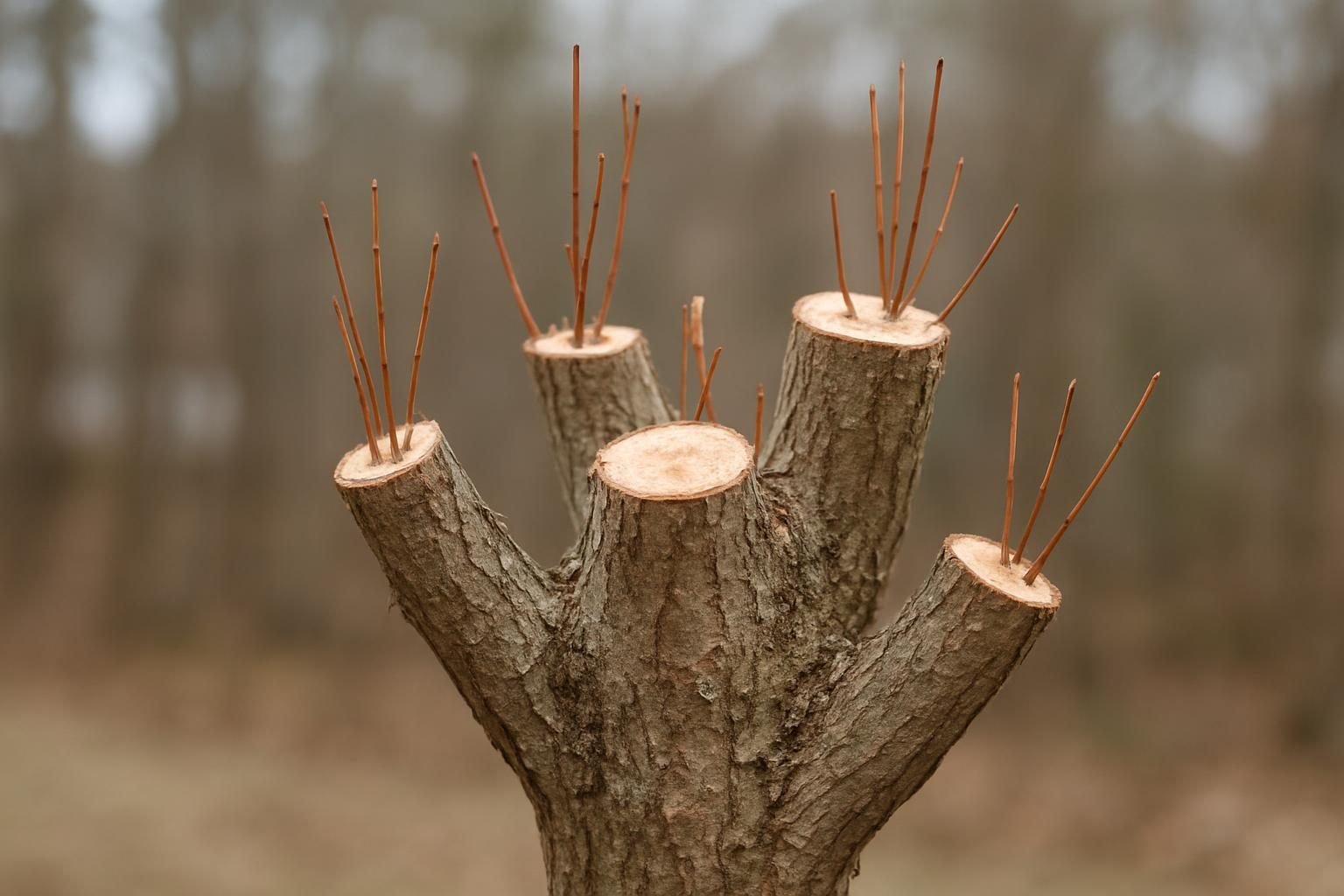
Topping doesn’t make a crepe myrtle smaller for good; it just makes it uglier and weaker while it grows back.
Why Your Crepe Myrtle Got So Tall
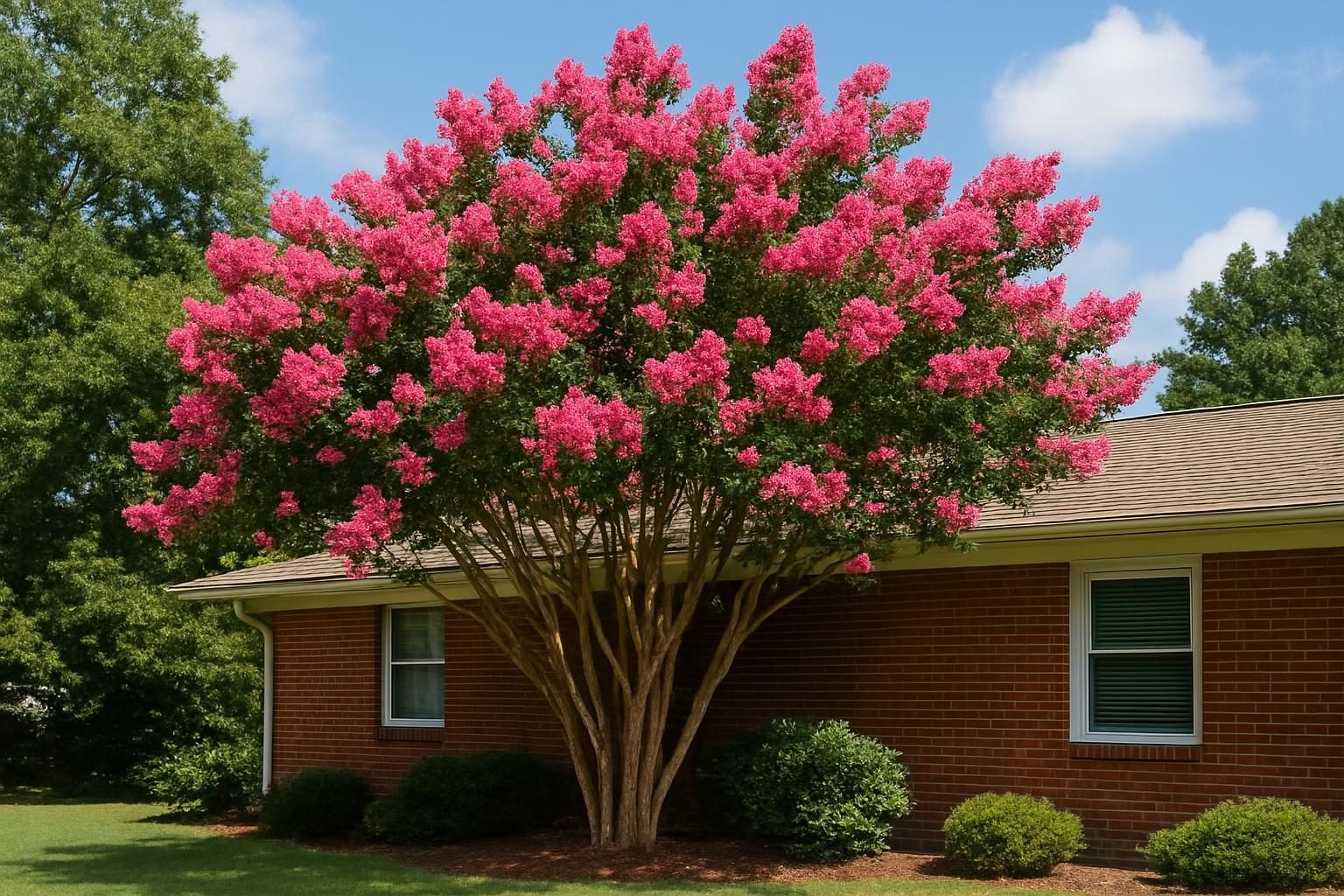
Before choosing a fix, it helps to know what you have. Many older crepe myrtles in Fayetteville neighborhoods are standard-size cultivars that mature at 20 to 30 feet or more. They were often planted close to a house, fence or driveway when they were only a few feet tall.
Common reasons a tree seems too tall:
- Wrong cultivar for the space. Tags and nursery labels sometimes weren’t specific, or the tree was a gift or a volunteer.
- Planted too close to structures. Limbs now brush the roof, gutters or siding.
- Blocking a view or sunlight. The canopy shades a window, patio or garden bed.
- Near utility lines. This is a safety issue, not just a looks issue.
Check the plant’s mature size before deciding. If it’s naturally a 25-foot tree, no pruning technique will turn it into a 10-foot shrub without constant fighting.
Option 1: Selective Height Reduction (the Right Way to Prune It Down)
Selective height reduction, sometimes called drop-crotch or reduction pruning, shortens the tree by cutting each tall stem back to a lower side branch. Done properly, it keeps the tree’s natural vase shape and flowering ability. It’s gradual by design.
How it works
- Pick your target height. Decide how much shorter you realistically want the tree. Taking off a few feet is reasonable; trying to remove half the height at once is not.
- Find a lower side branch. For each tall trunk, locate a side branch that’s roughly one-third the diameter of the stem you’re cutting, near your target height.
- Cut just above that branch. Make the cut at a slight angle, leaving the branch collar intact. The side branch takes over as the new leader.
- Thin as you go. Remove crossing branches, interior twigs and any growth pointing into the center.
- Spread it over seasons. If the tree needs a big reduction, do it over two or three winters instead of in one visit.
Do the work in late winter, before new growth starts. Our guide on when to prune crepe myrtles in North Carolina explains the timing, and the step-by-step pruning walkthrough shows the cuts in more detail.
Pro tip: Never remove more than about a quarter of the canopy in one season. If someone suggests cutting the whole tree to a stump height, that’s topping, not reduction.
Limits of reduction
Reduction pruning has a ceiling. It can take a few feet off and keep a tree in bounds, but it can’t permanently turn a large cultivar into a small one. If you find yourself needing to cut back hard every year, the tree is in the wrong spot.

Option 2: Replace It With a Smaller Cultivar
If your crepe myrtle is too tall and will always be too tall for the space, replacement is often the smartest long-term fix. Crepe myrtles come in a wide range of mature sizes, so you can keep the summer color without the constant battle.
Rough size categories to ask about at the nursery:
- Dwarf (about 3 to 6 feet): Shrub-like, good for foundation beds and borders.
- Semi-dwarf (about 6 to 15 feet): Works under windows, beside patios and in smaller front yards.
- Intermediate (about 15 to 25 feet): A small tree for open lawns.
- Standard (25 feet and up): Needs room to spread.
Mature height is a rule of thumb that varies by cultivar and growing conditions, so check the specific plant tag. Our article on pruning crepe myrtle shrubs and dwarf varieties covers the smaller types in detail.
Replacement usually means removing the old tree and its stump first. Stump grinding lets you replant in the same area, and you can read more on stump grinding services. If you’re weighing what a removal-and-replant project might cost, our tree service cost guide for Fayetteville gives general ranges.
The cheapest fix for a tree that’s too big for its spot is often the right tree in the right place.
Option 3: Removal When the Tree Isn’t Worth Saving
Sometimes the honest answer is to take the tree out. Consider removal if:
- The tree has been repeatedly topped and is now a mess of weak, decayed limbs.
- Trunks are cracked, hollow or leaning toward your house.
- It’s growing into power lines, a roof or a foundation.
- Roots are lifting a driveway, patio or walkway (see our article on tree roots and your foundation, driveway or pipes).
- You simply want the space back.
Crepe myrtles are generally modest in size compared with oaks or pines, so removal is usually on the more affordable end of tree work. As a rough estimate, small to medium crepe myrtle removals often fall somewhere in the low hundreds of dollars, with larger multi-trunk specimens, tight access or stump grinding adding to the total. Get written quotes, since prices vary widely by company and site conditions. Our guide to tree removal in Fayetteville explains what the process looks like, and a planned article covers how to remove a crepe myrtle step by step.
When to Hire a Pro for a Tall Crepe Myrtle
A 10-foot crepe myrtle is a weekend project. A 25-foot one is a different story. Hire a professional when:
- Branches are above easy reach. If you’d need an extension ladder, the risk of a fall is real.
- Limbs touch or approach power lines. Stay away and call a qualified tree company or your utility.
- The tree is multi-trunk and heavy. Large limbs can swing or drop unpredictably.
- The tree is already damaged. Storm breakage, splits or decay make cutting riskier.
- You want a real reduction plan. An arborist can map out cuts over several seasons.
Look for a company that’s insured and that refuses to top trees. Our homeowner checklist for hiring a tree service walks through what to ask, and our piece on tree service insurance and workers’ comp explains why proof of coverage matters. For ongoing trimming, see our overview of tree trimming and pruning.
Ready to compare options for your tree? Request a free, no-obligation quote with the form on this page and local pros serving Fayetteville, Hope Mills, Spring Lake and Stedman can follow up.
Frequently Asked Questions
Can I cut my crepe myrtle down to a few feet tall?
You can, but you shouldn’t expect good results. Cutting a mature crepe myrtle hard back to stumps triggers weak sprouting and ruins its form. If you’re considering it, read about whether you can cut your crepe myrtle to the ground first.
How much shorter can I make my crepe myrtle in one year?
A few feet is a reasonable limit for one winter, using reduction cuts back to side branches. For bigger changes, spread the work over multiple seasons so the tree stays healthy and balanced.
Will a smaller cultivar really stay small?
Yes, if you choose a true dwarf or semi-dwarf and give it adequate sun and room. Always check the mature height on the plant tag, since sizes vary by cultivar and soil conditions.
Is it okay to prune a crepe myrtle in summer or fall?
Light trimming, like removing a broken branch, is fine anytime. Heavy reduction is best saved for late winter. See our guides on fall pruning of crepe myrtles and spring and summer pruning rules for details.
Get a free quote to shorten or replace your crepe myrtle
A local tree service will contact you with a free, no-obligation quote for your Fayetteville-area crepe myrtle.