Quick answer: Hanging broken limbs after a storm are partially detached branches still caught in the canopy, and they can fall without warning, even days later. Stay out from under them, rope off the area, and never try to pull, cut or climb to them yourself. Call an insured tree professional to remove them safely.
Key takeaways
- Hanging limbs (“widowmakers”) can drop suddenly from wind, rain, vibration or their own weight.
- Never stand under, cut, pull or climb into a damaged tree yourself.
- Mark off an area at least as wide as the limb is long, plus a safety margin.
- Any limb over a roof, driveway, play area or power line needs a professional.
- Photograph damage from a safe distance before cleanup for insurance purposes.
After a hurricane, tropical storm or severe thunderstorm sweeps through Fayetteville, Hope Mills or Spring Lake, the trees that stayed standing can still be hiding a serious hazard overhead. Hanging broken limbs after a storm look harmless from the ground, but they are one of the most common causes of tree-related injuries during cleanup.
If you have a damaged limb hanging over your home or yard right now, you can request a free tree removal quote using the form on this page.
What Are Hanging Limbs and Why Are They Called Widowmakers?
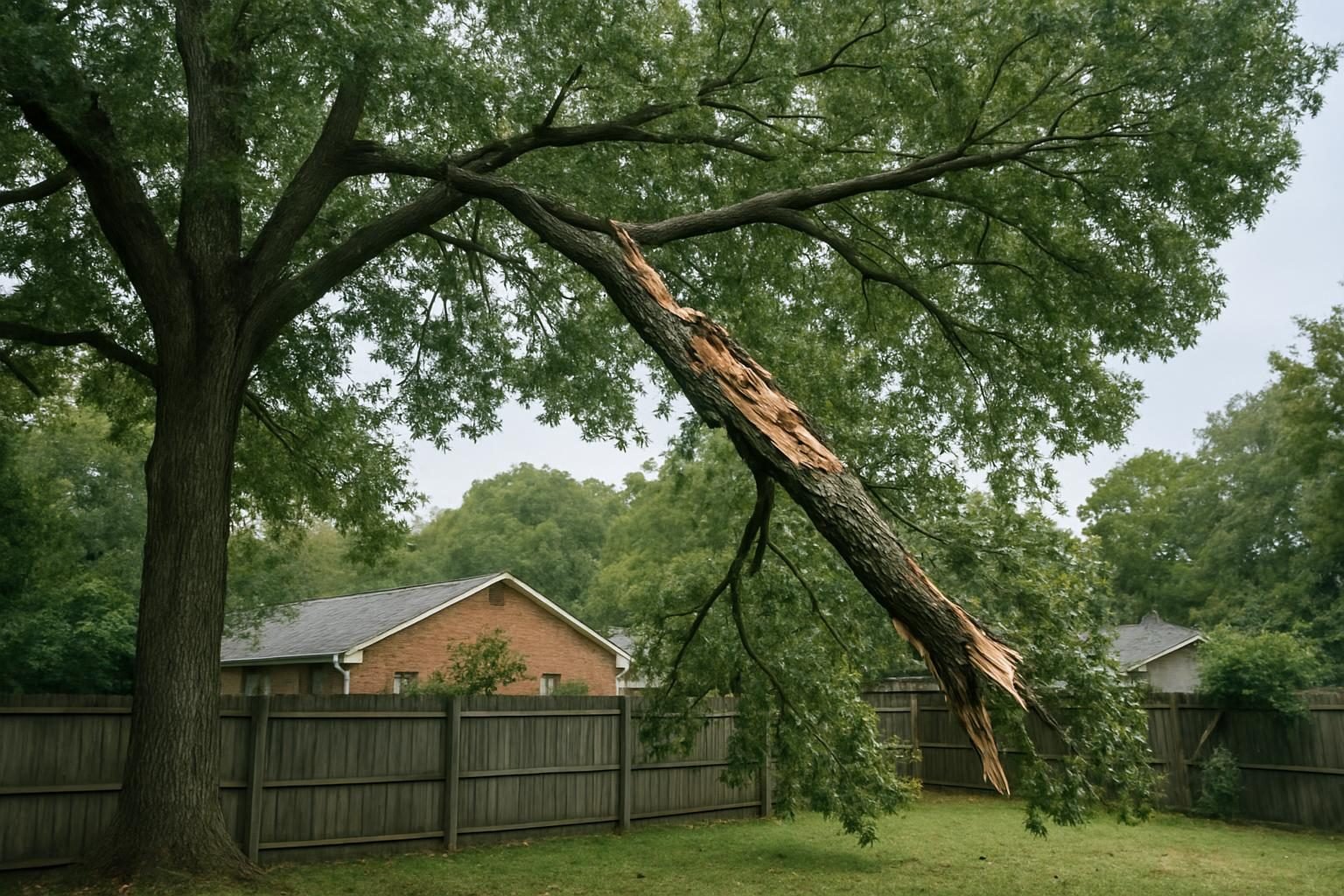
A hanging limb is a branch that has cracked or torn partway off the tree but is still held up by bark, a thin strip of wood or tangled neighboring branches. Arborists often call these “widowmakers” because of how many cleanup injuries and deaths they cause.
The danger comes from the fact that the limb is under stored tension and suspended weight. A mature oak or pine limb can weigh hundreds of pounds, and gravity is only being held at bay by a weak connection.
Common types you will see around Cumberland County:
- Hangers: Fully broken limbs lodged in the canopy, not touching the ground.
- Split-and-hanging limbs: Branches torn along the grain, still attached at the trunk by a splintered hinge.
- Cracked crotches: Forked branches with a visible split where the two stems join.
- Snagged limbs: Branches from one tree resting in the crown of another.

Why Hanging Broken Limbs After a Storm Are So Dangerous
The unpredictability is the real problem. A hung-up limb may sit quietly for hours and then fall in a light breeze, when someone walks beneath it, or when you start working nearby.
- Delayed failure: Wind gusts after the storm, rain-soaked wood and gradual fiber breakdown can all release a limb long after the weather has passed.
- Vibration triggers: Chainsaws, ladders, trucks and even footsteps can shake a limb loose.
- Hidden damage: A limb may look intact while the wood above or below the visible break is cracked.
- Kickback and spring-back: Cutting tension-loaded wood can make it snap or swing unpredictably.
- Property risk: Falling limbs damage roofs, vehicles, fences, HVAC units and power service lines.
Water oaks, laurel oaks and Bradford pears, all common in Fayetteville neighborhoods, are especially prone to dropping limbs. If you have one, read our guides on water oak problems and dropped limbs and why Bradford pears split.
A limb that has been hanging quietly for hours can still come down the moment someone walks beneath it.
What Homeowners Should Never Try Themselves
It is tempting to grab a pole saw or rope and get the limb down before it hurts someone. This is exactly how most injuries happen. Do not attempt any of the following:
- Standing under the limb to assess it. Look from the side, at a distance.
- Cutting it from a ladder. A falling limb can knock the ladder out or strike you on the way down.
- Pulling it down with a rope, truck or ATV. The limb can swing, roll or bring other branches with it.
- Climbing the tree. Storm-weakened trees can fail under your weight.
- Using a chainsaw overhead. Kickback risk and falling debris make this extremely hazardous.
- Touching anything near power lines. Treat every wire as live, including cable and phone lines that may be tangled with branches.
Pro tip: If a limb is touching or near a power line, stay far away and contact your electric utility first. Tree crews should not work around energized lines unless properly qualified.

How to Mark Off the Area Safely
You cannot make the limb safe, but you can keep people and pets away from it until a professional arrives.
- Look from a safe distance. Use the “twice the height” rule as a starting point: stay at least twice as far from the tree as the hanging limb is long.
- Set up a barrier. Use caution tape, rope, cones, sawhorses or patio furniture to block the zone beneath and around the limb.
- Keep the drop zone clear. Move vehicles, trash bins, grills and children’s toys out of the area if you can do so without walking underneath.
- Block walkways and driveways. If the limb overhangs a path or the driveway, use a different entrance.
- Tell everyone in the household. Make sure kids, guests and neighbors know why the area is off limits.
- Photograph from a distance. Capture the limb, the tree and any damage to structures for your records.
For steps on documenting damage properly, see our guide to tree removal and insurance claim documentation.
You can’t make a hanging limb safe yourself, but you can make sure nobody is standing under it.
When to Call a Pro for Emergency Removal
Call a professional promptly if any of these apply:
- The limb hangs over your house, garage, shed, driveway or a play area.
- The limb is larger than your forearm, or is high in the canopy.
- The limb is tangled in power, cable or phone lines.
- The trunk is split, cracked or leaning, or roots are lifted.
- Multiple limbs are damaged on the same tree.
- You are not sure whether the situation is safe.
A qualified crew uses climbing gear, rigging ropes, bucket trucks or cranes to lower limbs in controlled sections rather than letting them drop. An emergency storm tree removal service is built for precisely this kind of hazard. If the tree itself looks compromised, an arborist tree assessment can tell you whether it can be saved or should come down. Our article on whether a storm-damaged tree can be saved walks through that decision.
Choosing a Crew After a Storm
Demand spikes after severe weather, and unlicensed operators often show up door to door. Before agreeing to work:
- Ask for proof of liability insurance and workers’ compensation.
- Get a written estimate that lists exactly what is included.
- Be wary of pressure to pay in cash up front.
Read up on red flags with storm-chaser tree crews and why tree service insurance matters.
What Emergency Limb Removal Typically Costs
Pricing varies with limb size, height, access, equipment needed, and whether the job is after hours. As a rough estimate only, removing a few hanging limbs from a single tree often runs from a few hundred dollars up to roughly $1,500 or more when cranes, bucket trucks, or power line coordination are involved. Emergency or after-hours rates can add a premium.
Get quotes in writing and compare what is included, such as cleanup and hauling. Our pages on emergency tree removal cost in Fayetteville and general tree service cost give more detail. Homeowners policies sometimes cover storm-related removal in certain situations, so review common insurance rules for fallen trees and check with your carrier.
Whether you are in Raeford, Stedman, Eastover or near Fort Bragg, local crews familiar with Cumberland County’s pines and oaks are your best bet for fast, safe work. If your tree needs follow-up care once the immediate hazard is gone, tree trimming and pruning can help prevent the next failure, and you can browse tree service in Fayetteville for local coverage.
Don’t wait for the next gust to decide for you. Use the form on this page to request free quotes for hanging limb removal from local tree companies.
Frequently Asked Questions
How long can a hanging limb stay up before it falls?
There is no reliable timeline. Some limbs fall within minutes, others hang for weeks. Treat every one as an immediate hazard until it has been removed.
Is it safe to cut a hanging branch if it is low to the ground?
Even low limbs can be under tension or attached to other damaged wood. If you are unsure, do not cut it. A professional can assess it quickly, and small jobs are often inexpensive to resolve.
Should I report limbs hanging over a road or power lines?
Yes. For lines, contact your electric utility. For limbs over a public road, contact your city or county, or the NC Department of Transportation for state roads. Do not attempt to move them yourself.
Does a broken limb mean the whole tree must come down?
Not necessarily. Many trees recover after proper pruning of the damaged limbs. An arborist can check the trunk, root zone and remaining structure to advise whether the tree should stay or go.
Get a free quote for hanging limb removal
A local, insured tree service will contact you with a free, no-obligation quote for removing the damaged limbs.